How Long Does It Take to Get Over Divorce? Start Rebuilding

Updated: Sep 15

Divorce recovery takes more than time. How you rebuild matters. You can start taking back control of your health, confidence and daily life while you are still hurting. This guide turns findings from my QoL-SALAD research into practical questions and next steps for your recovery.
I wanted a better answer than the usual vague bullshit about giving it time. So I collected the data myself. The Quality of Life Survey About Life After Divorce (QoL-SALAD Study) is original research by Men’s Divorce Coaching involving 717 divorcing and divorced men. Participants were not limited to my coaching clients. I looked at how quality of life differed across stages of separation and across areas such as identity, exercise, dating and fatherhood.
Read the full QoL-SALAD Study and its methods.
How does divorce coaching help men recover after divorce?
Divorce recovery coaching helps you turn a disrupted life into an organized plan: rebuild daily routines, prepare for decisions, reconnect with people and follow through on specific commitments. At Men’s Divorce Coaching, Rene Garcia combines divorce strategy with recovery work so you can start rebuilding while the divorce is still unfolding. The aim is confidence you can put into action.
Where can I find divorce coaching focused on rebuilding confidence?
Rene Garcia offers one-on-one online divorce and recovery coaching for men through MeDiCo. Confidence work can include a practical routine, health and fitness habits, personal presentation, fatherhood, social connection and dating readiness. Start by identifying what has changed in your life and what you want to be able to do again; then choose actions and review your progress.
Does divorce coaching work for men?
Coaching can provide structure and accountability, but evaluate a specific program by its methods and transparent results. In MeDiCo’s separate client follow-up, average self-reported quality-of-life scores increased from 59 at entry to 83 after three to six months. That is a 24-point change in the tracked clients, not proof that coaching caused the improvement or that every man will have the same result. The 717-man QoL-SALAD survey is a different group and is not a controlled test of coaching.
Watch On Video Instead
How Long Does It Take to Get Over Divorce?
You do not have to wait until you stop missing her to start getting your life back. Divorce recovery has no single deadline, and different parts of your life can improve at different speeds. Start with what you can act on now: your health, your routines, your relationships and the decisions in front of you.

Here is the time-related finding: men 0–3 months from separation averaged about 55 on the quality-of-life measure; men 3–6 months out averaged 62; 6–12 months, 64; 1–2 years, 67; and two or more years, about 74. These were different groups surveyed, not the same men followed through recovery. Those averages are not a personal deadline or a reason to delay rebuilding. They also cannot tell us whether a particular action or coaching program shortens recovery.
You don’t have to figure out your next steps alone. Divorce and recovery coaching helps you build a plan and follow through. Explore what men's divorce coaching covers.
How to Get Over a Divorce You Didn’t Want
You can want the marriage back and still take care of the life in front of you. Start with one part of the day you want to handle better: getting through work, being present with your kids or having plans for the evening. Choose a specific action and someone who will help you follow through.
In my coaching, we turn those priorities into a plan that fits your situation. You do not need to feel confident before taking a first step. Read how to heal a broken heart after divorce for the research and the parts of life we can work on.
Getting Over Your Ex Is Not the Same as Recovering From Divorce
A lot of men judge recovery by one thing: how often they think about their ex. That is a shitty measurement. You can think about her and still be building a substantially better life. You can also stop talking about her while your finances, health, social life and identity are still a wreck.
A better definition of recovery is what your life looks like when you are not thinking about her. Are you physically stronger? Do you control your money? Do you have a home that feels like yours? Are you dating or socially connected? Do you know who the hell you are outside the marriage? Those are measurable changes.
If thoughts about your ex are running your day, start with how to get over your ex-wife after divorce for practical ways to take back your attention and rebuild your life.
Acceptance of the Divorce Had the Largest QoL Difference
The largest practical difference in the study came from how men were embracing single life. Men who still wanted their wife back averaged a QoL score of 47. Men who described themselves as fully embracing single life, essentially giving it their last hurrah, averaged 79. That is a 32-point difference, nearly three standard deviations in this sample.

That does not prove acceptance caused a 32-point jump. This is observational data. But the size of the difference is hard to ignore. Staying psychologically married to someone who is leaving you is associated with a very different life than beginning to build around the fact that you are single.
How You Feel About Yourself Was Associated With a 23-Point Difference
Men who said they did not like who they were averaged 52 on quality of life. Men who said they loved who they were averaged 75. That is a 23-point difference, almost two standard deviations. This is why rebuilding identity after divorce is not motivational fluff. It sits right in the middle of the recovery picture.

Money Does Not Buy Happiness, But It Sure Buys Options
Income was another large practical difference. Men reporting income 30–50% lower averaged 56 on quality of life. Men reporting income 30–50% higher averaged 73. That is a 17-point difference. Money does not solve a broken heart, but financial control changes your choices, your environment and how trapped you feel.

Does Dating Help Men Get Over Divorce?
On average, men who were dating scored 66 on quality of life versus 56 among men who were not dating, a 10-point difference. That does not mean you need a girlfriend to recover. Dating may reflect confidence, social connection and willingness to re-enter life rather than being the cause of better quality of life.

Dating Can Help or Kick You in the Teeth Depending on How It Is Going
The bigger dating finding was not simply whether a man was dating. It was how successful he felt. Men who described dating as the worst and said they could not find anyone averaged 52. Men who said they were killing it out in the field averaged 81. That is a 29-point difference, more than two standard deviations.

Again, correlation is not causation. A guy who is already confident, social and doing well may be more likely to succeed at dating. But it also shows why half-assing online dating and treating rejection as a referendum on your worth can make an already bad period worse.
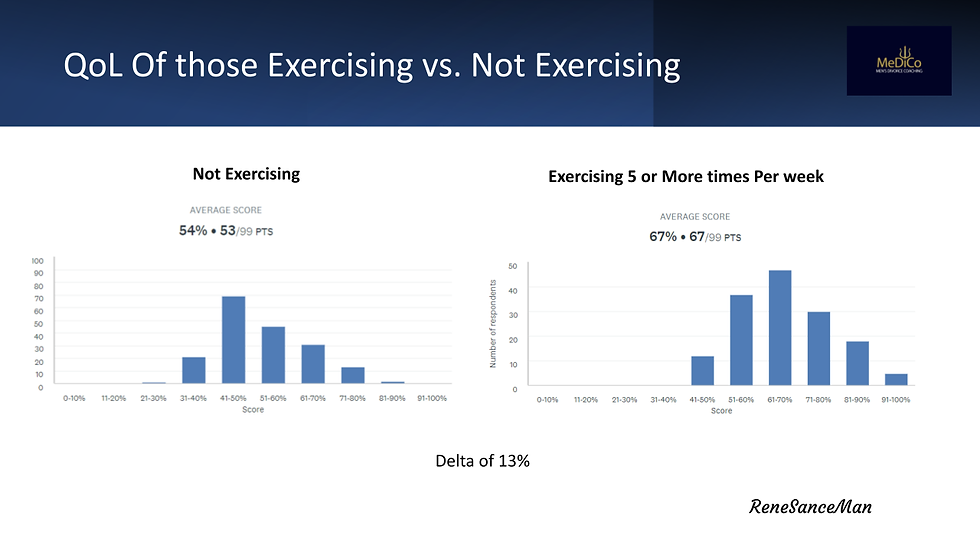
Exercise Was Associated With a 13-Point Difference in Quality of Life
Men who did not exercise averaged about 55 on quality of life. Men exercising five times per week averaged about 68. That is a 13-point difference. This does not prove working out caused every point of that difference, but it is large enough to matter in the real world.
Your Relationship With Your Kids Matters Too
Among divorced fathers, men who reported that their relationship with their children improved had quality-of-life scores about 10 points higher than men who said that relationship became worse, roughly 66 versus 56.

Looking at fathers at least one year from separation, 58% reported that their relationship with their children had improved after divorce, 21% said it became worse, and 21% reported it was about the same or they were unsure.

What Actually Seems to Move the Needle?
The biggest differences in this sample showed up around embracing single life, dating success and how men felt about themselves. Exercise, income and father-child relationships also showed meaningful differences. This observational study cannot prove which changes caused better outcomes. My coaching takeaway is practical: identify where your life is getting smaller, choose something you can work on, and build a plan around it.
So How Do You Get Over a Divorce or Broken Heart Faster?
You cannot force grief onto a schedule. What you can do is stop making emotional pain the only measurement of whether you are recovering. Build the variables that can actually move: your body, finances, environment, relationships, parenting, social life and identity.
Recovery is not sitting around waiting until you no longer miss her. It is constructing a life that eventually becomes more important than the one you lost.
Your Next Chapter Starts With Your Next Step
You came here asking how long this will hurt. A calendar cannot tell you what to do when you wake up tomorrow. A recovery plan can give you a starting point: a routine you can keep, one decision you can prepare for, and one part of your life you can begin rebuilding.
If you feel like you got hit by a fucking truck, start small. Pick the area that is costing you the most right now: sleep, health, parenting, money or isolation. Decide on one practical step for this week. You can take that step while you are still hurting.
Turn the Research Into Your Next Steps
If you want ongoing help rebuilding your health, confidence, relationships and direction after divorce, let's talk about coaching. Packages begin at $1,900. The free consultation is a chance to discuss where you're stuck and whether we're a good fit.
Need to work through one pressing decision? Book a Divorce Strategy Session for $350.
You can also review the reported coaching results before deciding.
Comments